Sunday, 12 February 2012

Sucre and Cordillera de los Frailles

We arrived in white washed Sucre (although from our persepective it was more like orange washed) and we stayed in a really beautiful place overlooking the city from up on the hillside. Sucre is mercifully low. We spent a while here but found the threats of the pre-carnival water balloon attacks, the drive by water canyon soakings and our complete inability to find any decent food places open a bit wearing. The buildings in the centre were really pretty and we found a really tasty chocolate shop so that was a bonus but we were glad to find Condor trekkers a non-profit organisation and decided to do a three day trek in the countryside around Sucre, on an Inca trail and to see actual dinosaur footprints!


Look at this little pero trying to bite my socks off! Ooo he was a cute one. This is when we visited the indigenous textile museum to see the impressive Jalq'a textile weavings. They are incredible works of art. We also got to see a lady weaving one.


This was the view from our bedroom window!


Then the time had come and we were off on our trek. The incredible sunrise made meeting up at 5am worth it and our first view of the Inca trail was pretty beaut too.


We passed a lot of people in the three days we were walking and we gave them a lot of coca leaves and oranges and apples to the kids. Unbelievably beautiful and shy kids.


The landscape we were walking through was so colourful! Various shades of reds, greens, blues, greys, yellows. You could see how the land had been carved out through water and weather over so many years. Some of the areas looked so alien like.


We had lunch by a chocolate milkshake waterfall.


Can you see the crazy trail we had to follow on shifting sand?? Mental.


We stayed in houses in the local villages where a lot of the houses were made from mud adobe bricks.


So many crazy alien landscapes.


Then we came across the dinosaur footprints! A giant lizard walked through here about 130 million years ago. That was a really incredible thought. 


We stood and sat and talked by some fantastically beautiful vistas.


The weather was kind to us. We had huge storms every night but they held out until we were safely tucked up in our beds at night. After the second night's storm a lot of the roads had washed away so it was a nail biting hairy ride all the way back to Sucre. Some times we had to get out whilst the bus wobbled over streams and soft mud on the ground and then walk for a kilometre or so. It was incredible how fit the older people were, hurrying along beside us and giggling all the way. Even while travelling in the bus we all held our breath as it hung at nearly 45 degrees over the cliffs of sheer kilometres worth of drop. Crazy journey!


After getting back to Sucre we were off back up into the mountains to La Paz.


Saturday, 11 February 2012

Potosi and The Mines

Potosi is an old city where a few hundred years ago 160,000 people lived and worked due to Cerro Rico from which they were extracting silver and other minerals. They said that the silver they found in Cerro Rico bank rolled Spain for over two hundred years. Potosi is very high up at 4070m and we felt it! Whilst still trying to recover from the affects of altitude sickness on the Salar D'Uyuni tour we definitely continued to feel the affects during our time in Potosi. Headaches, dizziness, breathlessness and super big gluey blood bogies. Not nice. But coca leaves helped and so did drinking coca tea. We were told that Potosi was not a nice place, grey and harsh. We found it a lovely, friendly and chilled out place. The buildings are ornate and there are sculptures all around the park.


We decided that we would go on a tour to visit the mines and the men and women still working in them, in some of the worst working conditions in the world. We were worried that it might feel a little too voyeuristic but we were really glad we went as it was a huge eye opener and gave us a huge sense of perspective. Whenever I'm having a bad day at work... well it doesn't even compare!

We were taken to meet our guide who introduced himself like this! 


Nuts! But seriously Juan was a really lovely and hugely interesting person. He told us all about his own personal experience with the mines. His father had worked down there all his short life and Juan worked down there for three years until he had a bad accident and his wife said that his health was more important than money. Miners average life expectancy is 42. Then he had luck and found this job as a guide and is now studying to be a teacher. His four kids, he wants to go to university and his eldest one is studying chemical and mineral engineering. We all discussed how little the miners get for their work and even the people working at the refinery (where they extract the different minerals through various chemical reactions) get paid minimal amounts. They have a short life expectancy too, at 55. The people who get all the money are the refinery owners. The owner of the refinery that we visited had several cars and several homes whilst the people who work for him get pitons for a week full of twelve hour days. They make their money exporting the minerals to other countries that have better technologies for extracting purer minerals. Then these countries sell the minerals back to Bolivia. We had a long discussion about why Bolivia doesn't employ these technologies and smelt their own minerals. Juan described how there is a large movement in the younger generation to make this more of a reality in the future. However to study to become a mineral engineer (like his son) takes seven years. Meanwhile the rich get richer and the poor stay poor and die really young and horribly.


We got given trousers, jackets, boots and miners hats to wear and we stopped at the miners market on the way to buy presents for the miners. Below is some dynamite that we bought them!


Then we stopped at the refinery and Juan explained how the processes work.


We met up with some of the workers working in the refinery and gave them some coca leaves.


Then we drove up towards the mine, stopping to take pictures as we looked down over Potosi.


This was where we got our first glimpse of the mine at the bottom of Cerro Rico. There are 700 mines but only 250 mines are operative today. 


Then there was nothing for it but to head into the underground! The cooperative mine we were visiting was called Candelaria Mina Collectivo and it was about 350 years old. Juan's father had worked in this mine, so had he and he knew a lot of the miners as we walked about. Then we headed into the mountain. 850m in to be precise and the ended up going about 37m down to level 3 where we met some miner shovelling in 35 degrees. Level 4, five more metres deep, was the deepest the miners go, there is no oxygen down there so they have to have it pumped down through tubes.


We needed scarves to cover our mouths as there are a lot of toxic fumes down them mines! Lanterns on and wide eyed we started to walk into the darkness.


First of all the tunnel was dark but easy to walk almost standing upright through. We were following the train tracks along which huge carriages are pushed and pulled full of tonnes of the extracted minerals.


Then the passageways started getting very tight! Before we knew it we were scrambling on our bums sliding deeper and deeper into the mine.


We stopped just before descending to level 3 and Juan told us a lot about how they mine and the real meaning of the mining cooperatives. We turned all our lanterns off and experienced the deep dark blackness of the underground world.

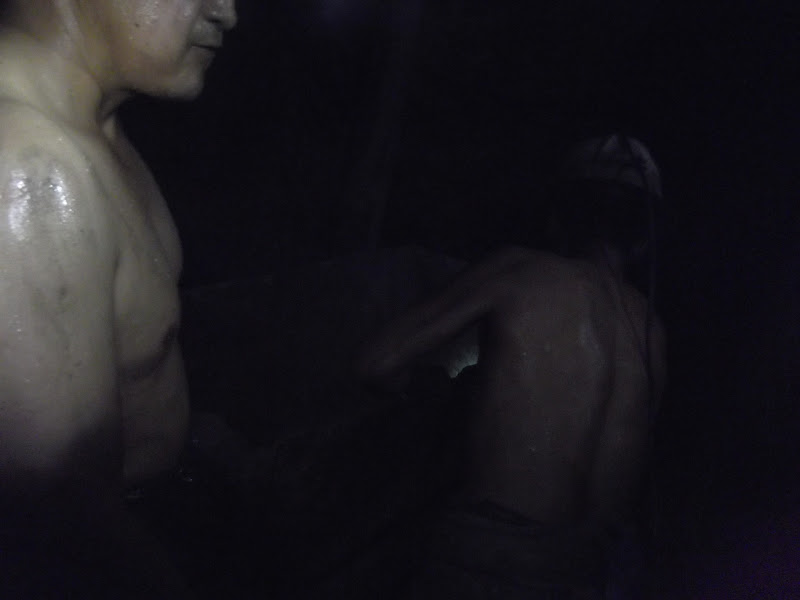
We had been meeting miners all along our walking but none were in such awful conditions as those we were with as they worked down in level 3. The heat, the fumes and their exertion were utterly unbelievable.


A lot of the miners we met had huge terrible scars on their bodies, it was an unreal place.


After scrambling back up the passageway, next to sheer drops of the shafts we were crawling next to, and squeezing through the gaps in the ground we made it nearly back up to the upright passage. Before we did that and after a few seconds to catch our breath, as the altitude was taking it's toll on our exertion and we were nearly passing out, we crawled along another passageway to visit the Tio (uncle). Tio is whom the miners believe is the owner of the minerals that they mine and so they give him offerings to appease him to enable them to keep extracting the minerals underground. 
Visiting the mines was an incredible experience and one I sharn't forget. We learned a lot and is was a harrowing experience but one that gave me huge perspective on what some people go through to survive in their lives.

Salar D'Uyuni

Our four day trip to the Salt plane of Uyuni or Salar D'Uyuni was a mindblowing trip of surreal and magical sights. It is almost indescribable and certainly impossible to capture on film. However I will attempt to record a small part of our experience in the deserts and mountainous landscape of south west Bolivia. The photos will do most of the talking in this post! The landscape we saw there will no doubt stay part of my dreams for a long time to come. We began our trip in Tupiza, just over the border from Argentina and a beautiful, friendly and relaxed town. We packed our jeep and with another couple, Viktor the driver and Emma the cook we set off for the high desert region. We ascended to a head squeezing height of 4885m and slept at a scaryily head banging height of 4600m, saw mountains, volcanoes, deserts, lagunas, geisers, insane rainbow colours in the landscape, thermal springs,  llamas, flamingoes, vicunas, a desert fox, a viscacha, felt shortness of breath, dizzy, brain-squeezing headaches, chewed coca leaves, drank coca tea, ate amazingly tasty food and had four of the most memorable days of my life so far...


Day 1
On Day 1 the terrain changed as we drove from dry burnt red rocks to green moss to grey mountains. At lunchtime we arrived at a grassy plane and ate lunch next to hundreds of llamas. There were a group busy mating, bizzarly humming away as they did so, and a couple of really new babies - the after birth of one lay nearby and must have been only one hour old. We saw many mines, a couple were big but most were tiny with only about sixteen miners and their families living and working there, manually extracting the minerals from under the ground. The sky was full of amazingly beautiful clouds for the entire day. We felt short of breath and dizzy as we climbed and slept at a height of 4200m.


I am chewing coca leaves that help with altitude but also sent my cheeks completely numb!


Beautiful, giggly Emma cooked us amazingly tasty food!


Here is the pueblo where we slept on the first night at 4200m next to astonishing mountains.


Day 2
We began the second day with a visit to the ruins of a pueblo that was built 200 years ago due to all the gold and silver to be found and mined nearby. We drove passed and were surrounded all day by volcanoes and reached the highest I have ever been 4885m. Due to the volcanic activity in the area the land was very fertile and covered with bright green grass under a blue sky. We encountered our first flamingoes on a laguna, complete with fascinating reflections which kept my camera busy the entire time! As we passed through the area the colours melted into each other as the flamingoes flew through them. We arrived at lunchtime at some natural thermal springs with the most astounding view across the multicoloured landscape of the desert and under a blue sky. Along the way we passed Laguna Verde and Laguna Blanca which meant we were fifteen minutes from Chile. The next place we jumped out of the jeep was at some geisers. We saw the vertical steam columns, smelt the egg of the sulphur and marvelled at the bubbling earth. Then we visited the Laguna Rojo, made red by tiny algae. Here were incredible colours flowing into one another - the red of the lake, the green, grey and yellow of the landscape the bright pink of the flamingoes, which harnessed the wind as they flew like the clappers passed us! Surrounding us were two volcanoes, Volcan Uturuncu at 6008m high and Volcan Llicancahur at 5950m high which marked the beginning of the Andes and was owned half by Chile and half by Bolivia. Altogether a day of surreal, dreamlike landscapes of immense beauty and breathtaking wonder. We slept at the height of 4600m but I only found this out the following morning which didn't help my panic in the middle of the night feeling like my brain was going to explode in my skull. 


Day 3
The third day began with the surreal piedras of the desert, the first photo is of the famous piedra de arbol or tree stone. We found the huge stones carved by the wind and weather to represent various things such as faces, trees and mushrooms! We visited more lagunas named locally as the 'Jewels of the High Andes'. So named for their various colours; green, red and green, white and clear, white clear and green, and white respectively. Small medicinal plants grew everywhere but no cacti or trees as they can't grow easily over 3600m. We saw three different types of flamingoes; Chilean (black and white), Andean (the biggest) and Hams (yellow and black on beak). Also an incredible desert fox legging it through the desert travelling as fast as our jeep, overtaking us and crossing our path to leap up the side of some desert rocks. We took lunch in the amazing desert, in view of the volcanoes, and a viscacha joined us. A viscacha is a small furry cuddly creature who looks like a cross between a rabbit and a chinchilla. Along our drive we also saw many vicunas, the timid and quite rare cousin of the llama and alpaca with incredibly soft fur. We saw yet another volcano in the region, this time still smoking! Volcan Ollague at a height of 5860m, again half owned by Chile and half by Bolivia. We arrived and slept on the edge of the huge Salar, or salt plane and slept in a hotel completely made of salt; bricks, floor, ceiling, decorations all.


Day 4
On our fourth and last morning we awoke before the sun and headed across the salt plane towards the island in the middle. Now among the eight jeeps that had stuck together, looking after one another out in the wild only three decided that they would brave the water on the salt plane (as it is the rainy season making a lot of places in Bolivia inaccessible). We were lucky enough that Viktor was a very experienced driver and felt able to take us! We stopped to watch as el Sol rose and then continued to the island. Just as the sun was rising in the sky we climbed the small hill on top of the mountain to take in the vista of the entire salt plane. The hill is covered with exceptionally old and huge cacti. We admired the view for some time and then took breakfast on the edge of the plane. Then we drove onto the lake until we were completely surrounded by bright white terrain under a powder blue sky holding puffy white clouds. As we passed over large areas of water the reflection of the sky created the most surreal landscape yet!! It was breath takingly incredible. Then we came to stop in an area of complete white under the blue sky. Here we had the typical fun with perspective that people always have in photos of this place. Finally we drove to the salt hotel in the middle of the salt plane, paused and then continued towards Uyuni and the other edge of the salt plane. Here we saw people working on the salt, gathering it into piles for trucks to come and remove it to transport it around Bolivia. Finally we drove to our hostal in Uyuni had lunch together and then went our separate ways. What an incredible experience and one we are unlikely to forget for the rest of our lives.